
Ultra-Processed Foods: How to Identify Them, What to Avoid, and WhatRead More
Ultra-Processed Foods: How to Identify Them, What to Avoid, and What to Eat Instead
Summary
Ultra-processed foods are industrial formulations consisting largely of refined components and additives and not whole foods, and their excessive consumption has repeatedly been associated with greater chances of becoming overweight or obese, developing type 2 diabetes, cardiovascular diseases, and other chronic ailments. Recognizing such products becomes easy if one knows that one has to look at the label for identification. It would be easy to reduce the consumption of such products, as it need not involve the exclusion of all processed foods consumed by an individual at one go but could be done by switching from the most frequently consumed products, such as snacks, drinks, and breakfast foods. In India, the average family diet of dal, sabzi, roti or rice, and curd is closer to a whole-food diet.
Table of Contents
What Are Ultra-Processed Foods? Foods to Avoid and Healthy Alternatives
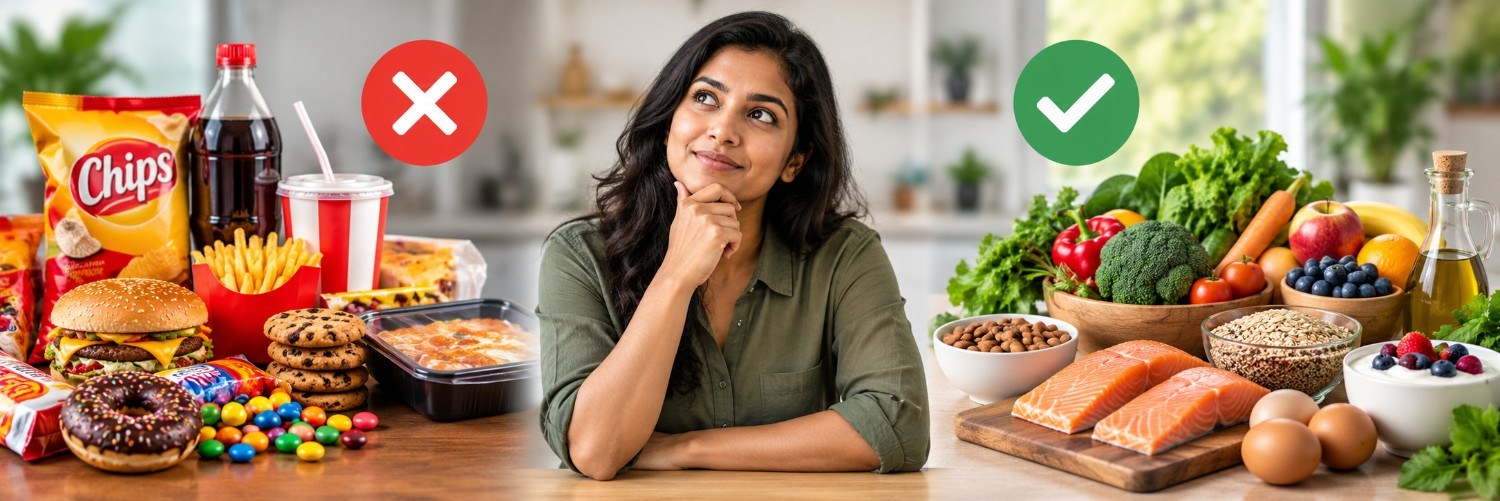
Walk down any supermarket aisle in India today and a large share of what lines the shelves, flavoured chips, instant noodles, sweetened yogurt drinks, packaged bakery items, falls into a category nutrition scientists call ultra-processed food, or UPF. These foods are easy to use, cheap, and last long on shelves. This is precisely why these foods have begun to form an increasing part of the regular diet in Indian households. However, there has been a significant amount of research to show that consumption of such food items results in obesity, diabetes, heart diseases, etc.. This guide explains what actually makes a food ultra-processed, how to identify one from its ingredient list in under a minute, which everyday foods fall into this category, and how to build meals around whole foods without giving up convenience altogether.
What Are Ultra-Processed Foods?
The term “ultra-processed food” comes from the NOVA food classification system, developed by Brazilian epidemiologist Carlos Monteiro and colleagues at the University of Sao Paulo in 2009. NOVA sorts all food into four groups by the extent and purpose of processing rather than by nutrient content alone: unprocessed or minimally processed foods, processed culinary ingredients (oil, sugar, salt), processed foods (canned vegetables, cheese, freshly made bread), and ultra-processed foods. Ultra-processed foods are industrial formulations made mostly from substances extracted or derived from food, such as modified starches, protein isolates, and hydrogenated oils, combined with additives that have little or no use in a home kitchen, including flavour enhancers, emulsifiers, and artificial colours. Whole, recognisable food is usually absent or makes up only a small part of the formulation.
Ultra-processed foods vs processed foods
| Aspect | Whole / Minimally Processed Foods | Ultra-Processed Foods |
|---|---|---|
|
What it is
|
A whole or minimally processed food with one or two ingredients added for taste, texture, or preservation
|
An industrial formulation built mostly from refined substances and food additives
|
|
Typical ingredients |
Salt, sugar, oil, or vinegar added to a recognisable food
|
Modified starches, protein isolates, hydrogenated oils, flavour compounds, emulsifiers, colours. |
|
Examples |
Canned vegetables, paneer, tinned fish, simple bread made from flour, yeast, and salt |
Packaged namkeen, flavoured chips, instant noodles, sugary breakfast cereal, soft drinks |
|
Ingredient list |
Short, with familiar, home-kitchen ingredients
|
Long, with unfamiliar, industrial-sounding names
|
|
Nutrient profile
|
Close to the original whole food
|
Often high in added sugar, salt, refined starch, or unhealthy fats, with fibre and micronutrients reduced
|
Ultra-processed foods vs processed foods
- It is made up of extracted or purified compounds, but not whole compounds, such as starch, proteins, or hydrogenated and interesterified oils.
- It contains additives with little or no home-kitchen use, including emulsifiers, flavour enhancers, artificial colours, high-intensity sweeteners, and anti-caking agents.
- Little or no whole, intact food is actually present in the formulation.
- It is engineered to be highly palatable, shelf-stable, and ready to eat or heat with minimal preparation.
- It is often marketed with health-sounding claims, such as “multigrain” or “no added colour”, regardless of the underlying formulation.
How to Read a Food Label for Ultra-Processed Ingredients
Identifying an ultra-processed food does not require special training. Most of the information is on the pack itself, in the ingredient list rather than the nutrition panel.
Start with the ingredient list
The ingredients are ordered by weight, from high to low, so the first three ingredients provide a lot of information about the real composition of the product. The presence of flour or starch, refined sugar, including glucose syrup, invert sugar, or fructose, as well as a refined oil or fat in the first three ingredients is a sign that one should be careful about consuming the product.
Ingredients commonly associated with ultra-processing
- High-fructose corn syrup/glucose-fructose syrup
- Hydrogenated or interesterified vegetable oil
- Modified starch
- Protein isolates or concentrates used as bulking agents rather than for nutrition (soy protein isolate, whey protein isolate)
- Emulsifiers such as mono- and diglycerides, polysorbates, or engineered lecithin blends
- Flavour enhancers such as monosodium glutamate or hydrolysed proteins
- Artificial colours and flavours
- Anti-caking and bulking agents
- Artificial or high-intensity sweeteners
A single ingredient from this list does not automatically make a food ultra-processed. Small amounts of lecithin or natural flavour also appear in some minimally processed foods. It is the overall formulation, how many of these substances appear together and how central they are to the product, that matters.
A simple supermarket test
- Read the ingredient list first, before looking at the nutrition panel.
- Look for the industrial formulations and additives listed above. More than one or two is a clear flag.
- Ask how much of the product is actually recognisable whole food. If the whole-food ingredient is a minor part of a long, chemical-heavy list, treat the product as ultra-processed.
Common Myths About Ultra-Processed Foods
- Myth: “All packaged food is ultra-processed.”
- Fact: Not really. Just because something comes in a packet or can doesn’t mean it’s ultra-processed. Foods like canned dal, frozen vegetables, yogurt and packaged atta are processed, but that doesn’t make them unhealthy by default. What really matters is what’s in the food and how it has been processed, not just the packaging.
- Myth: “If the label says no added colour or natural flavour, it can’t be ultra-processed.”
- Fact: Not quite. A product can make these claims and still contain ingredients such as refined starches, protein isolates and emulsifiers. So, instead of relying on one claim on the front of the pack, it’s worth checking the full ingredient list.
- Myth: “Homemade fried snacks are automatically healthier than packaged ones.”
- Fact: Homemade doesn’t automatically make something healthier. What really matters is what goes into it, how it’s prepared, and how often you eat it. Whether it’s made at home or bought from a shop is only one part of the picture.
- Myth: “Ultra-processed foods only affect body weight.”
- Fact: Weight is only one part of the picture. Research has linked higher intake of ultra-processed foods with several health outcomes, including cardiometabolic problems, mental health concerns and higher overall mortality risk.
- Myth: “You have to stop eating all ultra-processed foods overnight to see any benefit.”
- Fact: It doesn’t have to be an all-or-nothing change. You don’t need to completely overhaul your diet overnight. Start by cutting back on the ultra-processed foods you eat most often and make a few simple changes that you can stick with over time. Even small, consistent steps can help you move towards a healthier eating pattern.
Ultra-Processed Foods List: Common Examples
Packaged snacks
Flavoured potato chips, extruded namkeen and puffs, cheese balls, packaged bhujia mixtures, and flavoured popcorn.
Sugary foods and desserts
Packaged biscuits and cookies, cakes and pastries with long shelf lives, ice cream made with stabilisers and emulsifiers, candy, and chocolate-coated wafers.
Breakfast foods
Sugary breakfast cereals, flavoured and pre-sweetened instant oats sachets, packaged granola or muesli bars, and white bread or buns made with dough conditioners and preservatives.
Instant and ready-to-eat foods
Instant noodles, instant soup mixes, frozen ready meals, packaged pasta with seasoning sachets, and reconstituted meat products such as nuggets, sausages, and salami.
Drinks
Carbonated soft drinks, packaged “juice drinks” with added sugar, energy drinks, sweetened flavoured milk and yogurt drinks, and instant coffee or tea premixes with creamer and sugar built in.
Sauces, spreads, and condiments
Ketchup made with high-fructose corn syrup, mayonnaise-style spreads, instant flavoured chutneys, and packaged salad dressings with stabilisers and emulsifiers.
Ready-to-cook masalas and instant mixes
Some of the gravy pastes and instant mix powders use a high proportion of flavoring agents and anticaking agents. All packaged masalas are not ultra-processed, contrary to popular belief. Always read the label!
Processed vs Ultra-Processed Foods: What's the Difference?
A useful, quick decision rule: if you can imagine making the product in a home kitchen with ingredients bought from a local store, flour, oil, sugar, salt, and spices, it is likely processed or minimally processed. If the formulation depends on industrial techniques and additives you would never keep in a home kitchen, it is ultra-processed.
| Whole / Minimally Processed Foods | Ultra-Processed Foods |
|---|---|
|
Fermented idli or dosa batter made at home
|
Packaged instant idli mix with raising agents and preservatives |
|
Homemade plain dahi (curd) |
Flavoured, sweetened yogurt drink with added stabilisers |
|
Roasted chana or peanuts
|
Flavoured, extruded snack pellets
|
What Does Science Say About Cutting Back on Ultra-Processed Foods?
An umbrella review in the journal The BMJ conducted in 2024 brought together 45 meta-analyses based on 14 systematic reviews involving nearly 10 million individuals. The results indicated that increased consumption of ultra-processed food is positively associated with 32 outcomes with strong evidence pointing toward cardiovascular mortality, common mental disorders, type 2 diabetes, obesity, and all-cause mortality [3]. Since this evidence is observational, the results indicate an association but not causation of ultra-processing alone leading to all listed outcomes.
What controlled trials show
The clearest evidence for a direct, causal effect comes from a 2019 randomised crossover trial at the US National Institutes of Health led by Kevin Hall. Twenty adults spent two weeks on an ultra-processed diet and two weeks on a minimally processed diet, in random order, with both diets matched for presented calories, sugar, fat, salt, and fibre, and eating as much or as little as they wanted. Participants ate roughly 500 kcal a day more and gained weight on the ultra-processed diet, and lost weight on the minimally processed diet, even though the two diets were nutritionally matched on paper [2]. This is one of the few studies able to show that the degree of processing itself, not just the nutrient content, can drive higher food intake.
What research on UPFs still doesn't fully answer
The ultra-processed category is broad and includes some fortified or reformulated foods that are not necessarily nutritionally poor, so the NOVA classification has been criticised by some food scientists for grouping very different products together based mainly on processing method rather than nutrient content. Larger and longer controlled trials are still needed to confirm mechanisms. Given the consistency of the observational evidence and the results of the available randomised trial, most current dietary guidelines, including India’s, now recommend limiting regular, heavy intake of ultra-processed foods as a precaution rather than waiting for complete scientific certainty [4].
How to Reduce Ultra-Processed Foods Without Giving Up Convenience
Don't try to eliminate everything at once
Abrupt, all-or-nothing changes are hard to sustain. Aim for a gradual shift in overall pattern over several weeks rather than a single clean-out of the pantry.
Start with the foods you eat most often
Audit the items eaten daily or near-daily, such as a tea premix, packaged bread, or an evening snack, before worrying about occasional treats. Frequency matters more than any single indulgence.
Replace rather than simply restrict
Swap in a whole-food alternative at the same time as removing the ultra-processed version, rather than just cutting it out. For example, replace packaged biscuits with roasted makhana or fruit, instead of leaving a gap that gets filled by another packaged snack.
Whole Foods to Eat More Often
Fruits and vegetables
A variety of seasonal fruits and vegetables should ideally fill about half the plate at main meals.
Whole grains
Whole wheat atta, brown rice, and millets such as jowar, bajra, and ragi, along with plain oats.
Pulses and legumes
Dals, rajma, chana, and moong provide plant protein and fibre and form the base of most traditional Indian meals.
Nuts and seeds
Almonds, walnuts, flaxseed, chia, and pumpkin seeds work well as snacks in place of packaged options.
Eggs, fish, and minimally processed meats
Fresh cuts of chicken, fish, or eggs are preferable to reconstituted or cured products such as nuggets and sausages.
Plain dairy and fermented foods
Plain curd, paneer, and buttermilk without added sugar or flavour syrups.
Ultra-Processed Food Swaps: What to Eat Instead
| Ultra-Processed Food | Healthier Alternative |
|---|---|
|
Sugary cereal
|
Oats with fruit and nuts |
|
Fruit and nuts, or roasted makhana
|
Oats with fruit and nuts |
|
Instant noodles
|
Homemade vegetable noodles or whole-wheat sevai with vegetables
|
|
Flavoured chips
|
Roasted chana or masala peanuts
|
|
Packaged fruit juice
|
Whole fruit, or fresh nimbu paani without added syrup
|
|
Sweetened flavoured yogurt
|
Plain curd with fresh fruit
|
|
Instant soup mix
|
Homemade dal or vegetable soup
|
|
Sausages or nuggets
|
Grilled chicken, fish, or paneer
|
How to Build a Whole-Food-Based Plate
The ideal plate pattern for a balanced meal in Indian cuisine is quite straightforward: use half the plate for vegetables or salad, a fourth of the plate for whole grains or millets, and the other fourth for protein sources like dal, eggs, fish, or paneer. Include some good fats, like ghee or nuts, and a side dish of plain curd. Cook using whole spices and minimize the use of packaged sauces and ready made gravies.
A Simple 7-Day Approach to Eating Fewer Ultra-Processed Foods
Day 1: Replace tea/coffee premix and the packaged biscuits with plain tea and roasted nuts/fruit. Rest all remains the same.
Day 2: Replace one packaged snack item (like chips or namkeen) with roasted chana/makhana or fruit.
Day 3: Swap a sugary breakfast cereal for oats, poha, upma, or idli.
Day 4: Read the label on one condiment used daily, such as ketchup, mayonnaise, or instant chutney, and choose or prepare a simpler version.
Day 5: Replace one instant or ready meal, such as instant noodles or a frozen meal, with home-cooked dal-rice or khichdi.
Day 6: Swap a sweetened drink, such as a soft drink or packaged juice, for water, buttermilk, or fresh fruit.
Day 7: Review the week. Keep whichever swaps felt easy to sustain, and choose one more ultra-processed food to work on the following week.
Ultra-Processed Foods and Indian Diets
The eating pattern in India is changing from eating mostly home-prepared and little-processed foods to consuming more packaged foods in the cities due to convenience, dual incomes, and massive marketing of snacks and drinks. The recently updated 2024 Dietary Guidelines for Indians, which were published by the Indian Council of Medical Research and the National Institute of Nutrition, provided specific guidelines about limiting ultra-processed foods for the first time, along with other recommendations related to salt intake, added sugars, and abdominal obesity [4].
ICMR-NIN scientists have also proposed a “dual-axis” approach to future food labelling and regulation, one that weighs both the degree of processing and the nutrient content, such as fat, sugar, and salt, rather than penalising any packaged food outright. This reflects India’s specific situation of managing undernutrition and micronutrient deficiency alongside rising obesity, where some affordable, fortified packaged foods still play a useful role [5].
For the majority of Indian households, however, the scope for making the change seems to be less than expected because traditional Indian diets that are based on dal, sabzi, roti or rice, and curd already constitute a diet made up of whole foods. The reason being that in most cases, the consumption of highly processed foods happens through snacks, drinks, and breakfasts rather than through the main course.
Because ultra-processed diets are linked to a higher risk of conditions such as type 2 diabetes and fatty liver disease, a periodic preventive health checkup that includes blood sugar, HbA1c, and lipid profile can help track how dietary changes are affecting these markers over time. A nutritionist consultation can also help build a personalised whole-food plan, and anyone already managing elevated blood sugar may benefit from speaking with a diabetologist before making major dietary changes.
Frequently Asked Questions About Ultra-Processed Foods
What are ultra-processed foods?
Ultra-processed foods are industrial formulations made mostly from refined substances such as starches, protein isolates, and hydrogenated oils, combined with additives that have little or no use in a home kitchen, such as emulsifiers, flavour enhancers, and artificial colours.
What is the difference between processed and ultra-processed food?
Process foods are either whole or lightly processed foods that have one or two ingredients added to improve their flavor or shelf-life, such as canned veggies or plain bread. Ultra-processed foods are industry formulations that are made mostly from refined ingredients and additives.
What are the most common ultra-processed foods?
Packaged snacks and namkeen, sugary breakfast cereals, instant noodles, carbonated soft drinks, packaged biscuits and cakes, and reconstituted meat products such as sausages and nuggets are among the most common.
How can I tell if a food is ultra-processed?
Check the ingredient list rather than just the nutrition panel. A long list with several industrial-sounding additives, especially near the top, is a strong indicator.
What ingredients indicate ultra-processing?
Common signs include high fructose corn syrup, hydrogenated or interesterified oils, modified starch, protein isolates used as fillers, flavor enhancers like MSG, artificial colors, and high-intensity sweeteners.
Are all packaged foods ultra-processed?
The above products are either processed or minimally processed, but not ultra-processed foods. This is because it’s the formulation of ingredients that determines the food category and not merely its packaging.
Is bread an ultra-processed food?
It depends on the formulation. Bread that is composed of only four ingredients: flour, water, yeast, and salt, is processed but not ultra-processed. Commercially manufactured bread with dough conditioners, preservatives, and emulsifiers is ultra-processed.
Are breakfast cereals ultra-processed?
Many sweetened, flavoured breakfast cereals are ultra-processed, since they typically contain refined grains, added sugar, and flavouring or colouring agents. Plain oats or minimally processed muesli without these additions are not.
Are instant noodles ultra-processed?
Yes. Because instant noodles consist of refined flour, palm oil, and a seasoning pack made up of flavour enhancers, colours, and preservatives, they are considered ultra-processed foods.
Do I need to completely avoid ultra-processed foods?
It is not required that everyone completely avoid such products, as the studies have shown increased risk based on frequent and large consumption.so the priority is reducing the ultra-processed foods eaten most often rather than eliminating every packaged item.
What foods should I eat instead of ultra-processed foods?
Whole grains and millets, pulses and legumes, fresh fruits and vegetables, nuts and seeds, eggs and fish, and plain dairy such as curd and paneer are good whole-food alternatives.
Can reducing ultra-processed foods help with weight management?
A 2019 randomised controlled trial found that people spontaneously ate significantly more calories and gained weight on an ultra-processed diet compared with a nutritionally matched minimally processed diet, suggesting that reducing ultra-processed intake can support weight management.
Related Blogs
Fatty Liver Disease (MASLD): Symptoms, Causes, Stages, Diagnosis, Treatment & PreventionRead More

The Complete Guide to Preventive Health Checkups by Age Table ofRead More

Scrub Typhus Table of Contents Scrub Typhus: Symptoms, Causes, Treatment, andRead More


A fast-spreading disease has been detected in Congo by the healthRead More